Simulation Path Framework
DDSIM also provides a framework for exploiting arbitrary simulation paths (using the taskflow library) based on the methods proposed in [4].
Note
As of mqt-ddsim v2.0.0, the Cotengra-based workflow for translating circuits to tensor networks and deriving contraction strategies has been removed. If you want to check out the respective code, please checkout prior versions of mqt-ddsim.
A simulation path describes the order in which the individual MxV or MxM multiplications are conducted during the simulation of a quantum circuit.
It can be described as a list of tuples that identify the individual states/operations to be multiplied.
The initial state is always assigned ID 0, while the i-th operation is assigned ID i.
The result of a multiplication is assigned the next highest, unused ID, e.g., in a circuit with |G| gates the result of the first multiplication is assigned ID |G|+1.
The framework comes with several pre-defined simulation path strategies:
sequential(default): simulate the circuit sequentially from left to right using only MxV multiplicationspairwise_recursive: recursively group pairs of states and operations to form a binary tree of MxV/MxM multiplicationsbracket: group certain number of operations according to a givenbracket_sizealternating: start the simulation in the middle of the circuit and alternate between applications of gates “from the left” and “from the right” (useful for equivalence checking).
Simulating a simple circuit
This example shall serve as a showcase on how to use the simulation path framework (via Python). First, create the circuit to be simulated using qiskit, e.g., in this case a three-qubit GHZ state:
1from qiskit import QuantumCircuit
2
3circ = QuantumCircuit(3)
4# the initial state corresponds to ID 0
5circ.h(0)  # corresponds to ID 1
6circ.cx(0, 1)  # corresponds to ID 2
7circ.cx(0, 2)  # corresponds to ID 3
8
9circ.draw(output="mpl", style="iqp")
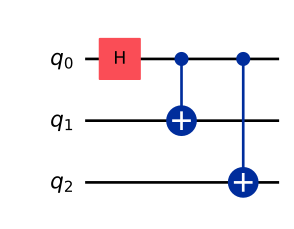
Then, obtain the simulation path framework qiskit backend. You can choose between the path_qasm_simulator and the path_statevector_simulator.
The first just yields a dictionary with the counts of the measurements, while the latter also provides the complete statevector (which, depending on the amount of qubits, might not fit in the available memory).
1from mqt.ddsim import DDSIMProvider
2
3provider = DDSIMProvider()
4backend = provider.get_backend("path_qasm_simulator")
Per default, the backend uses the sequential strategy. For this particular example, this means:
first, the Hadamard operation is applied to the initial state (
[0, 1] -> 4)then, the first CNOT is applied (
[4, 2] -> 5)finally, the last CNOT is applied (
[5, 3] -> 6)
The corresponding simulation path is thus described by [[0, 1], [4, 2], [5, 3]] and the final state is the one with ID 6.
The simulation is started by calling the run method on the backend, which takes several optional configuration parameters (such as the simulation path strategy).
For a complete list of configuration options see here.
1job = backend.run(circ)
2result = job.result()
3print(result.get_counts())
{'0': 478, '111': 546}
Configuration
The framework can be configured using multiple options (which can be passed to the backend.run() method):
mode: the simulation path mode to use (sequential,pairwise_recursive,bracket,alternating))bracket_size: the bracket size used for thebracketmode (default:2)alternating_start: the id of the operation to start with in thealternatingmode (default:0)seed: the random seed used for the simulator (default0, i.e., no particular seed).