Fault tolerant state preparation of Pauli eigenstates for CSS codes
The QECC package contains functionality for synthesizing and simulating fault tolerant and non-fault tolerant state preparation circuits for Pauli eigenstates of CSS codes. Currently it supports synthesizing circuits for preparing the \(|0\rangle_L^k\) and \(|+\rangle_L^k\) states of arbitrary \([[n,k,d]]\) CSS codes.
Synthesizing non-FT state preparation circuits
A non-fault tolerant preparation circuit can be generated directly from a CSS code. Let’s consider the Steane code which is a \([[7, 1, 3]]\) color code.
1from mqt.qecc import CSSCode
2
3steane_code = CSSCode.from_code_name("Steane")
4print(steane_code.stabs_as_pauli_strings())
['XXIIXXI', 'XIXIXIX', 'IIIXXXX', 'ZZIIZZI', 'ZIZIZIZ', 'IIIZZZZ']
A state preparation circuit for the logical \(|0\rangle_L\) of this code is a circuit that generates a state that is stabilized by all of the above Pauli operators and the logical \(Z_L\) operator of the Steane code.
The code is small enough that we can generate a CNOT-optimal state preparation circuit for it:
1from mqt.qecc.circuit_synthesis import gate_optimal_prep_circuit
2
3non_ft_sp = gate_optimal_prep_circuit(steane_code, zero_state=True, max_timeout=2)
4
5non_ft_sp.circ.draw(output="mpl", initial_state=True)
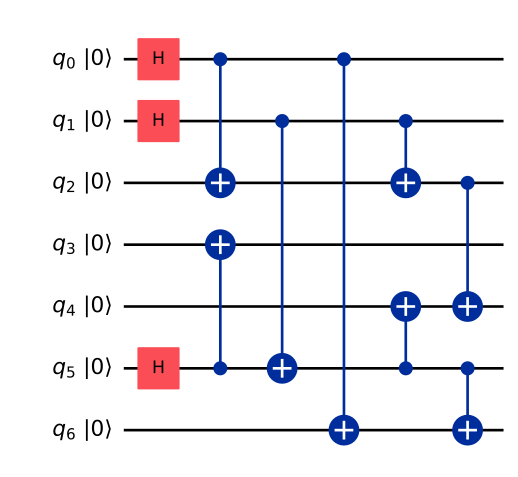
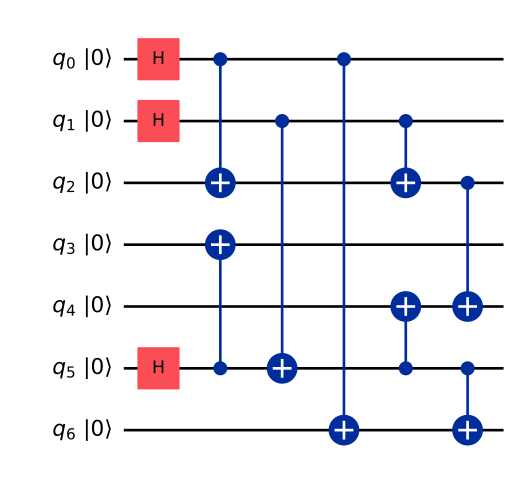
We see that the minimal number of CNOTs required to prepare the logical \(|0\rangle_L\) circuit of the Steane code is \(8\).
Synthesizing FT state preparation circuits
The circuit above is not fault-tolerant. For example, an \(X\) error on qubit \(q_1\) before the last CNOT propagates to a weight \(2\) X error on \(q_1\) and \(q_2\). This is to be expected since we apply two-qubit gates between the qubits of a single logical qubit.
A common method to turn a non-FT protocol into a fault tolerant one is through post-selection. We can try to detect whether an error was propagated through the circuit and restart the preparation in case of a detection event. A circuit performing such measurements is called a verification circuit.
Verification circuits need to be carefully constructed such that only stabilizers of the code are measured and no more measurements are performed than necessary. Finding good verification circuits is NP-complete.
QECC can automatically generate optimal verification circuits.
1from mqt.qecc.circuit_synthesis import gate_optimal_verification_circuit
2
3ft_sp = gate_optimal_verification_circuit(non_ft_sp)
4
5ft_sp.draw(output="mpl", initial_state=True)
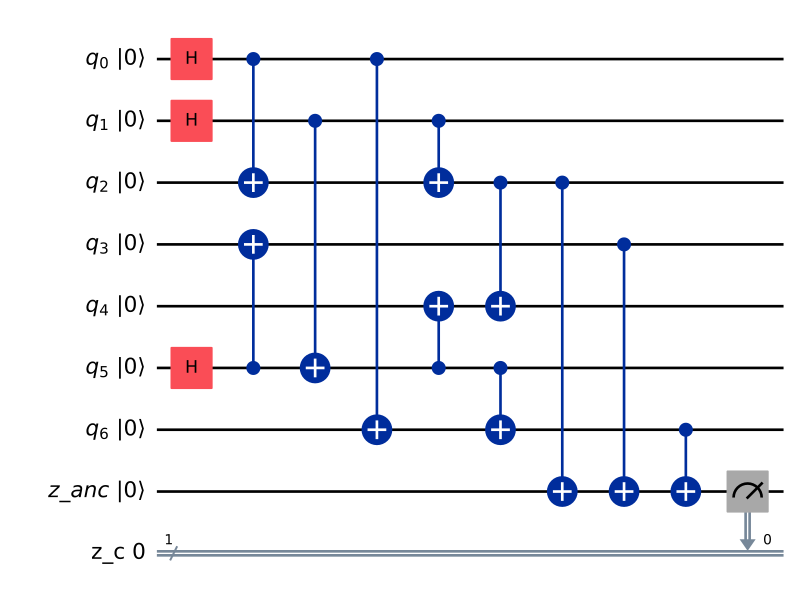
We have just automatically generated the known FT state preparation circuit for the Steane code: [1]. We see that if an X error happens on qubit \(q_1\) before the last CNOT causes the verification circuit to measure a \(-1\).
Simulating state preparation circuits
If we want to see the probability of a logical error happening after post-selecting, QECC provides simulation utilities that can quickly generate results. We can simulate the non-FT and FT circuits and compare the results.
 1from mqt.qecc.circuit_synthesis import VerificationNDFTStatePrepSimulator, CircuitLevelNoiseIdlingParallel
 2
 3p = 0.05
 4noise = CircuitLevelNoiseIdlingParallel(p_tqg=p, p_sqg=p, p_init=p, p_meas=p, p_idle=p/100)
 5
 6non_ft_simulator = VerificationNDFTStatePrepSimulator(
 7    non_ft_sp.circ, code=steane_code, zero_state=True
 8)
 9ft_simulator = VerificationNDFTStatePrepSimulator(
10    ft_sp, code=steane_code, zero_state=True
11)
12
13
14pl_non_ft, ra_non_ft, _, _ = non_ft_simulator.logical_error_rate(noise, min_errors=10)
15pl_ft, ra_ft, _, _ = ft_simulator.logical_error_rate(noise, min_errors=10)
16
17print(f"Logical error rate for non-FT state preparation: {pl_non_ft}")
18print(f"Logical error rate for FT state preparation: {pl_ft}")
Logical error rate for non-FT state preparation: 0.11443
Logical error rate for FT state preparation: 0.02422353602097322
The error rates seem quite close to each other. To properly judge the fault tolerance of the circuits we want to look at how the logical error rate scales with the physical error rate.
1ps = [0.1, 0.05, 0.01, 0.008, 0.006, 0.004, 0.002, 0.001]
2
3non_ft_simulator.plot_state_prep(ps, min_errors=50, p_idle_factor=0.01)
4ft_simulator.plot_state_prep(ps, min_errors=50, p_idle_factor=0.01)
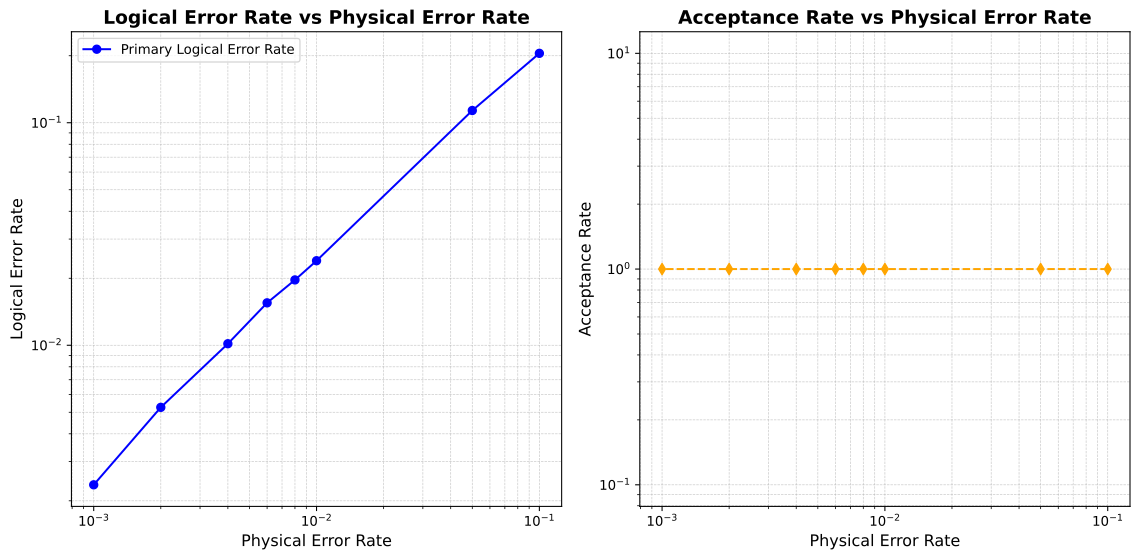
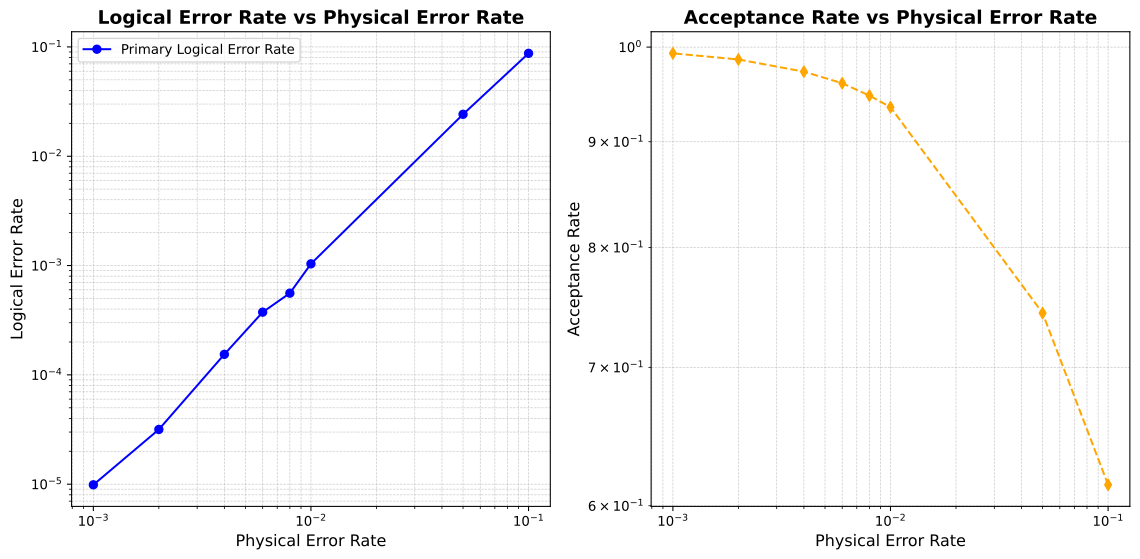
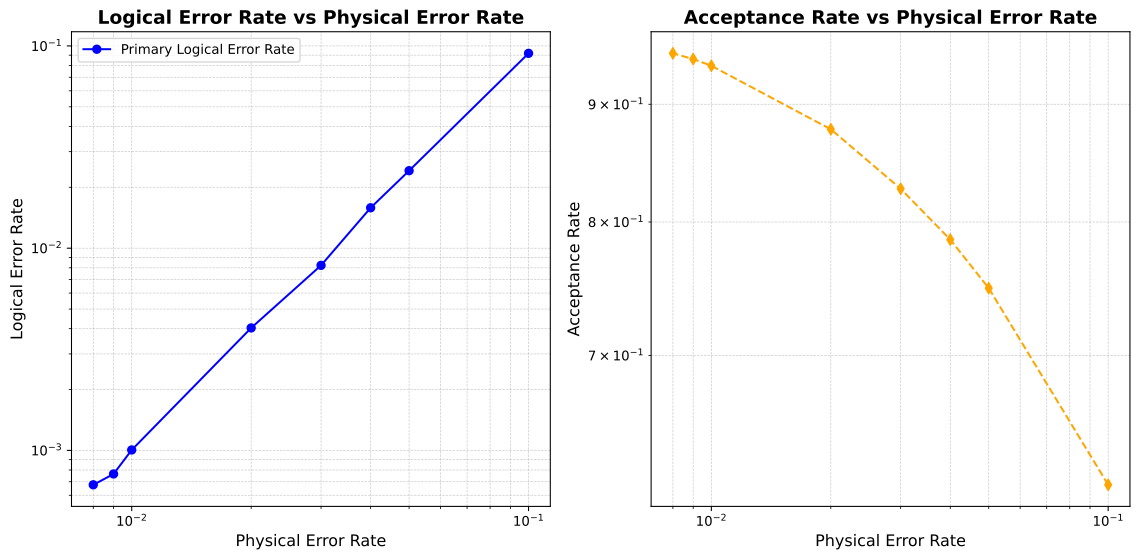
Indeed we observe a quadratic scaling for the fault tolerant state preparation circuit while the logical error rate scales linearly for the non-fault tolerant state preparation.
Beyond distance 3
Distance 3 circuits are particularly simple for fault tolerant state preparation because for the \(|0\rangle_L\) we can completely ignore Z errors. Due to error degeneracy any Z error is equivalent to a weight 1 or 0 error.
Additionally one has to pay special attention to the order of measurements in the verification circuits when more than one independent error in the state preparation circuit is considered.
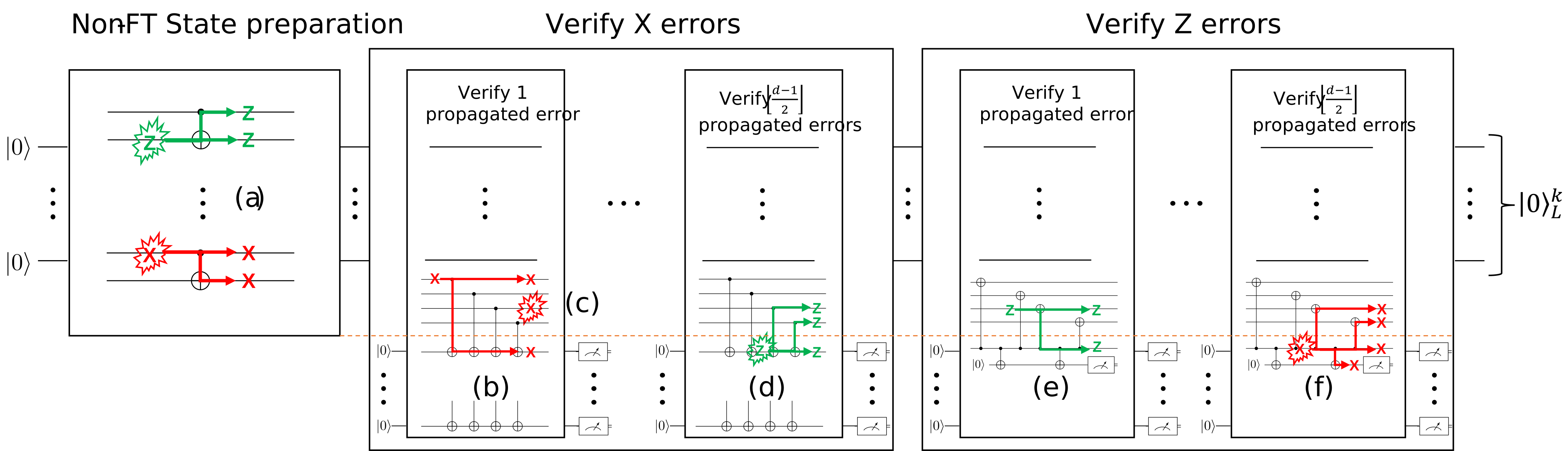
Because both error types are considered, the verification circuit now measures both X- and Z-stabilizers. Unfortunately a Z error in an X measurement can propagate to the data qubits and vice versa for Z measurements. Therefore, if we check for Z errors after we have checked for X errors the measurements might introduce more X errors on the data qubits. We can check those again but that would just turn the situation around; now Z errors can propagate to the data qubits.
Detecting such hook errors can be achieved via flag-fault tolerant stabilizer measurements [2]. Usually, information from such hook errors is used to augment an error correction scheme. But we can also use these flags as additional measurements on which we post-select. If one of the flags triggers, this indicates that a hook error happened and we reset.
By default QECC automatically performs such additional measurements when necessary. The general construction is sketched in the following figure.
Let’s consider a larger code to illustrate the point. The square-octagon color code is defined on the following lattice:
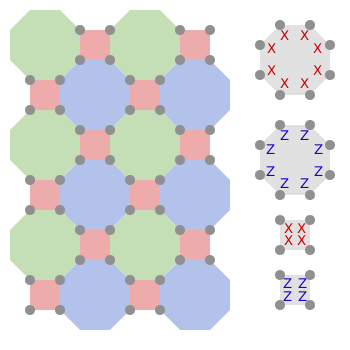
The distance 5 code uses 17 qubits from this lattice, i.e., we have a \([[17, 1, 5]]\) CSS code. Given the size of the code, synthesizing an optimal state preparation circuit might take a long time. QECC also has a fast heuristic state preparation circuit synthesis.
1from mqt.qecc.circuit_synthesis import heuristic_prep_circuit
2from mqt.qecc.codes import SquareOctagonColorCode
3
4cc = SquareOctagonColorCode(5)
5cc_non_ft_sp = heuristic_prep_circuit(cc, zero_state=True, optimize_depth=True)
6
7cc_non_ft_sp.circ.draw(output="mpl", initial_state=True, scale=0.7)
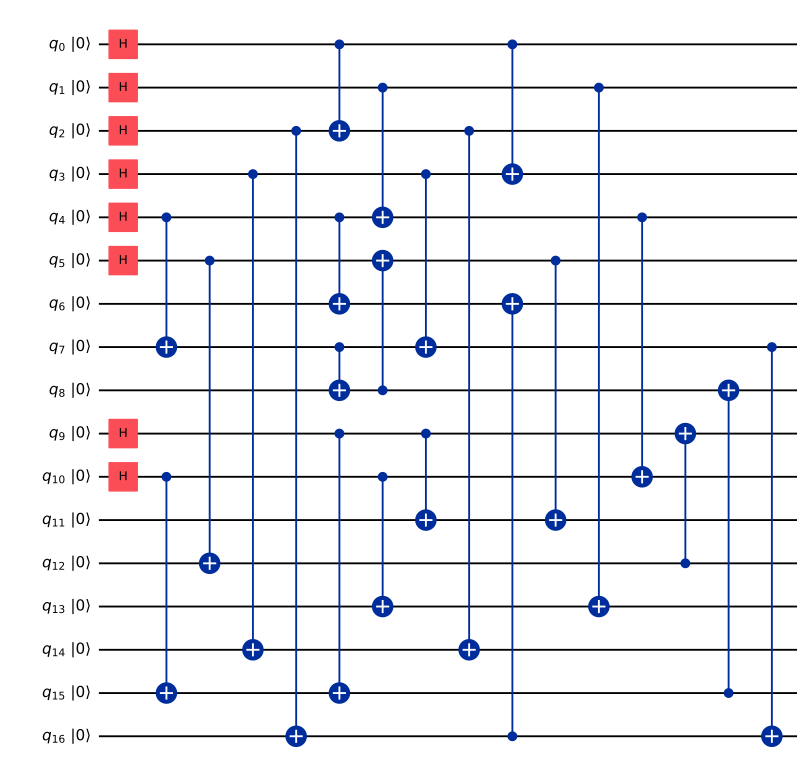
Even though optimal state preparation circuit synthesis seems out of range we can still synthesize good verification circuits in a short time if we give an initial guess on how many measurements we will need.
1cc_ft_sp = gate_optimal_verification_circuit(
2    cc_non_ft_sp, max_timeout=4, max_ancillas=3
3)
4
5cc_ft_sp.draw(output="mpl", initial_state=True, fold=-1, scale=0.2)
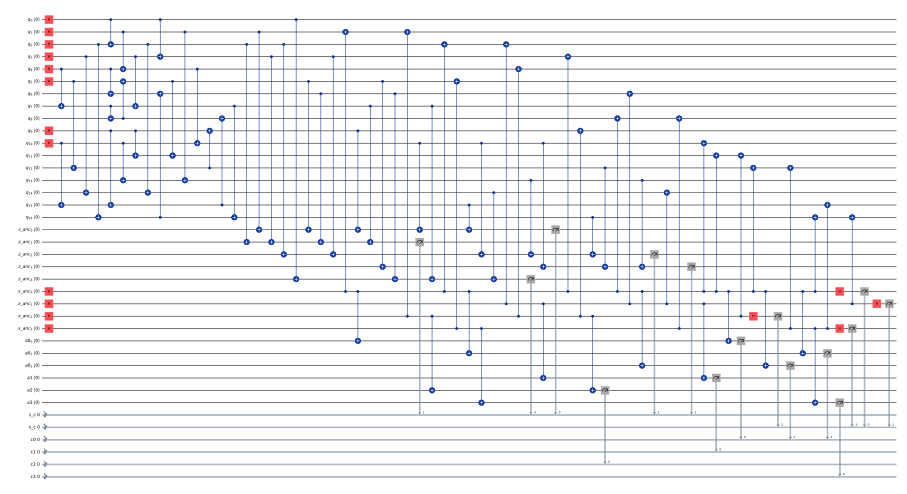
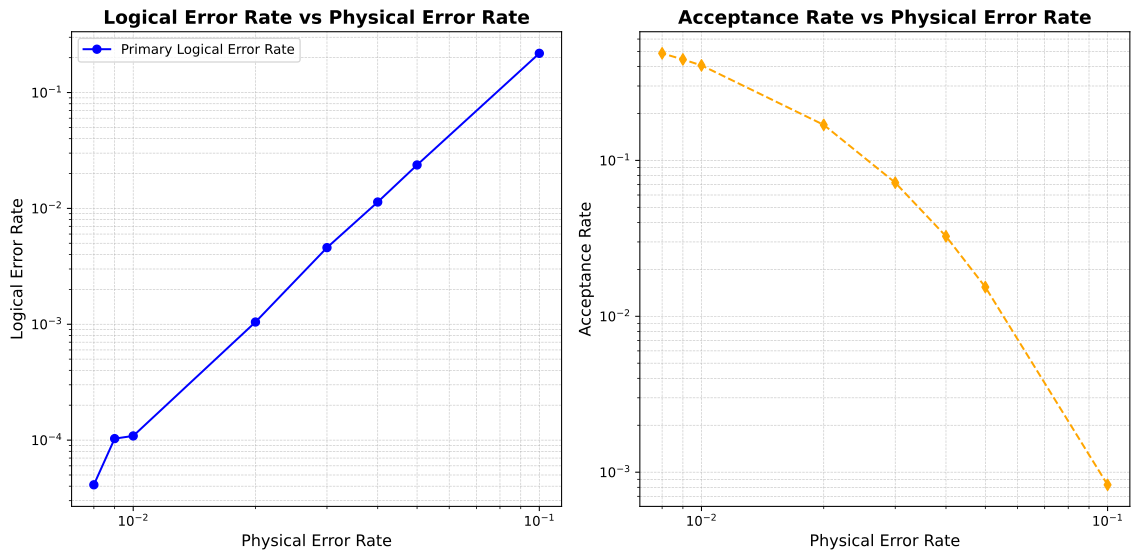
We see that the overhead for the verification overshadows the state preparation by a large margin. But this verification circuit is still much smaller than the naive variant of post-selecting on the stabilizer generators of the code.
 1from mqt.qecc.circuit_synthesis import naive_verification_circuit
 2
 3cc_ft_naive = naive_verification_circuit(cc_non_ft_sp)
 4
 5print(
 6    f"CNOTs required for naive FT state preparation: {cc_ft_naive.num_nonlocal_gates()}"
 7)
 8print(
 9    f"CNOTs required for optimized FT state preparation: {cc_ft_sp.num_nonlocal_gates()}"
10)
CNOTs required for naive FT state preparation: 145
CNOTs required for optimized FT state preparation: 77
We expect that the distance 5 color code should be prepared with a better logical error rate than the Steane code. And this is indeed the case:
1cc_simulator = VerificationNDFTStatePrepSimulator(cc_ft_sp, code=cc, zero_state=True)
2
3ps = [0.1, 0.05, 0.04, 0.03, 0.02, 0.01, 0.009, 0.008]
4
5ft_simulator.plot_state_prep(
6    ps, min_errors=50, p_idle_factor=0.01
7)  # simulate Steane code as comparison
8cc_simulator.plot_state_prep(ps, min_errors=50, p_idle_factor=0.01)
Deterministic state preparation (\(d < 5\))
A possible disadvantage of the above approach is that the verification circuits are non-deterministic. This means that we potentially have to run the circuit multiple times to successfully prepare the state. This can be circumvented by using the information gained from the verification measurements to possibly identify the dangerous error and correct it. If this this is done for every possible (single) error, we refer to the state preparation as deterministic [3].
For small codes (\(d < 5\) i.e., we need to consider only a single error) this problem is still tractable and can be solved in an optimal way using satisfiability solvers. QECC can automatically generate deterministic state preparation circuits for such codes.
For this we come back to our \(d=3\) Steane code.
1non_ft_sp.circ.draw(output="mpl", initial_state=True)
And initialize an instance of the deterministic verification helper class to facilitate the generation of the deterministic FT state preparation circuit.
1from mqt.qecc.circuit_synthesis import DeterministicVerificationHelper
2
3det_helper = DeterministicVerificationHelper(non_ft_sp)
Calling the get_solution method will generate the non-deterministic verification circuit using either the optimal or the heuristic method discussed above. The deterministic verification circuit, separated into X and Z correction layers) is then generated using the satisfiability solver.
1det_verify = det_helper.get_solution(use_optimal_verification=True)
2det_verify_x, det_verify_z = det_verify
Such a DeterministicVerification object contains the stabilizer measurements for the non-deterministic verification circuit, the stabilizer measurements for the different deterministic verification circuits, depending on the non-deterministic measurement outcomes, and the final correction Pauli operators that need to be applied to the data qubits.
The non-deterministic verification measurements are stored in the stabs attribute as a list of numpy arrays where each array represents a stabilizer measurement.
1det_verify_x.stabs
[array([0, 0, 1, 1, 0, 0, 1], dtype=int8)]
The deterministic verification measurements are stored in the det_stabs attribute as a dictionary where the keys are the non-deterministic measurement outcomes (converted to int) and the values is a tuple with the first element being the deterministic stabilizer measurements and the second element being again a dictionary with the Pauli corrections for the deterministic measurement outcomes.
For example for the Steane code whenever the non-deterministic verification triggers (1) the logical operator on qubits 2,3,6 hast to measured. If the outcome is 1, a Pauli correction on qubit 3 has to be applied, otherwise no correction is necessary.
1det_verify_x.det_correction
{1: ([array([0, 1, 0, 0, 1, 0, 1], dtype=int8)],
  {0: array([0, 0, 0, 0, 0, 0, 0]), 1: array([0, 0, 0, 0, 0, 0, 1])})}
For the case where the non-deterministic verification measurements need to be flagged (not the case for the Steane code), the hook_corrections attribute contains the additional stabilizer measurements and corrections in the same format as the det_stabs attribute.
1det_verify_x.hook_corrections
[{}]
Simulating deterministic state preparation circuits with Qsample
Warning
Due to qsample not being actively maintained, this feature is optional.
To use this feature, please locally install qsample or install QECC with the qsample extra.
The resulting DeterministicVerification object can be used to directly simulate the deterministic state preparation circuit using the Qsample under the hood. The NoisyDFTStatePrepSimulator class automatically constructs a valid Qsample protocol containing the correct circuits and conditional paths to simulate the deterministic state preparation. The passed Error Model and simulation parameters are directly passed to Qsample and explained in the Qsample documentation. Similarly also the Qsample callbacks can be used to e.g. directly plot the logical error rates.
 1from qsample import callbacks, noise
 2
 3from mqt.qecc.circuit_synthesis import NoisyDFTStatePrepSimulator
 4
 5error_model = noise.E1_1  # depolarizing error model
 6err_params = {"q": [1e-4, 5e-4, 1e-3, 5e-3, 1e-2, 5e-2, 1e-1, 5e-1]}
 7shots_dss = 2000
 8p_max = {"q": 0.01}
 9L = 1
10
11qsample_sim = NoisyDFTStatePrepSimulator(
12    non_ft_sp.circ, det_verify, steane_code, error_model
13)
14sampling_stats = qsample_sim.dss_logical_error_rates(
15    err_params, p_max, L, shots_dss, callbacks=[callbacks.PlotStats()]
16)
Circuits and Evaluations
The circuits and benchmark scripts used for our non-deterministic work [2], can be found here and for the deterministic work [3] here.