Transmon-Resonator Chain Emulation
This example simulates a qubit–resonator–qubit chain with coupled_transmon() (dipole coupling per coupled_transmon()).
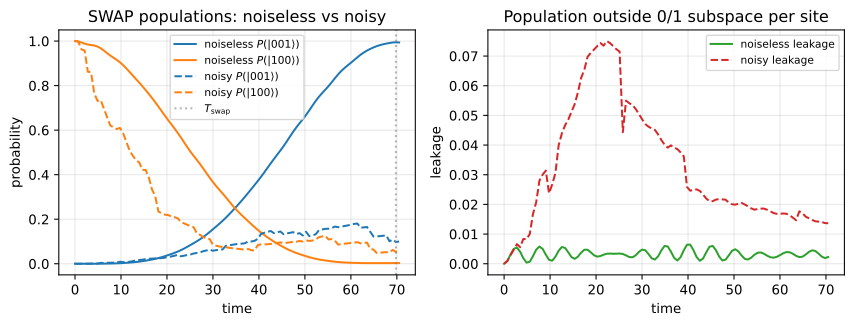
We prepare \(|100\rangle\) (left transmon excited) and evolve for one resonant swap period \(T_{\mathrm{swap}} = \pi/(\sqrt{2}\,g)\). The same evolution is run twice:
Noiseless — unitary analog simulation (TDVP on the MPO).
Noisy — open-system simulation with relaxation and dephasing on the qubit sites (TJM trajectories).
PVM observables track probabilities for bitstrings using only local indices \(0\) and \(1\) per site. With qubit_dim = resonator_dim = 3, population in the \(|2\rangle\) level appears as leakage (not counted in those bitstrings).
1. Hamiltonian and initial state
 1import numpy as np
 2from mqt.yaqs import Hamiltonian, State
 3
 4length = 3  # qubit – resonator – qubit
 5qubit_dim = 3
 6resonator_dim = 3
 7w_q = 4 / (2 * np.pi)
 8w_r = 4 / (2 * np.pi)
 9alpha = -0.3 / (2 * np.pi)
10g = 0.2 / (2 * np.pi)
11
12H_0 = Hamiltonian.coupled_transmon(
13    length=length,
14    qubit_dim=qubit_dim,
15    resonator_dim=resonator_dim,
16    qubit_freq=w_q,
17    resonator_freq=w_r,
18    anharmonicity=alpha,
19    coupling=g,
20)
21
22T_swap = np.pi / (np.sqrt(2) * g)
23dt = T_swap / 100
24
25# |100⟩: left qubit (site 0) in |1⟩
26state = State(
27    length,
28    initial="basis",
29    basis_string="100",
30    physical_dimensions=[qubit_dim, resonator_dim, qubit_dim],
31)
3. Noiseless SWAP
1import copy
2
3from mqt.yaqs import Simulator
4
5sim = Simulator(show_progress=False)
6result_clean = sim.run(copy.deepcopy(state), H_0, copy.deepcopy(sim_params))
/home/docs/checkouts/readthedocs.org/user_builds/mqt-yaqs/checkouts/latest/src/mqt/yaqs/simulator.py:372: ComplexWarning: Casting complex values to real discards the imaginary part
  result.trajectories[user_i][traj_index] = sorted_traj_data[sorted_i]
1p100_clean = pvm_curve(result_clean, "100")
2p001_clean = pvm_curve(result_clean, "001")
3times = sim_params.times
4. Noisy SWAP
Relaxation and dephasing on transmon sites (even indices). Built-in lowering and pauli_z processes are 2×2; for qubit_dim = 3 we pass explicit jump matrices (Destroy and a computational-subspace dephasing operator). For log-normal and other distributed noise strengths, see Realistic Noise Models.
 1from mqt.yaqs import NoiseModel
 2from mqt.yaqs.core.libraries.gate_library import Destroy
 3
 4relax = Destroy(qubit_dim).matrix
 5dephase = np.diag([1.0, -1.0, 1.0]).astype(complex)  # |2⟩ unaffected
 6
 7noise_model = NoiseModel(
 8    [{"name": "t1", "sites": [i], "strength": 0.03, "matrix": relax} for i in (0, 2)]
 9    + [{"name": "dephase", "sites": [i], "strength": 0.02, "matrix": dephase} for i in (0, 2)]
10)
11
12noisy_params = AnalogSimParams(
13    observables=[Observable(bstr) for bstr in all_bitstrings],
14    elapsed_time=T_swap,
15    dt=dt,
16    sample_timesteps=True,
17    num_traj=32,
18    random_seed=7,
19)
20
21result_noisy = sim.run(copy.deepcopy(state), H_0, noisy_params, noise_model)
1p100_noisy = pvm_curve(result_noisy, "100")
2p001_noisy = pvm_curve(result_noisy, "001")
5. Comparison plot
 1import matplotlib.pyplot as plt
 2
 3fig, (ax_pop, ax_leak) = plt.subplots(1, 2, figsize=(9, 3.5))
 4
 5ax_pop.plot(times, p001_clean, "-", color="tab:blue", label=r"noiseless $P(|001\rangle)$")
 6ax_pop.plot(times, p100_clean, "-", color="tab:orange", label=r"noiseless $P(|100\rangle)$")
 7ax_pop.plot(times, p001_noisy, "--", color="tab:blue", label=r"noisy $P(|001\rangle)$")
 8ax_pop.plot(times, p100_noisy, "--", color="tab:orange", label=r"noisy $P(|100\rangle)$")
 9ax_pop.axvline(T_swap, color="gray", linestyle=":", alpha=0.6, label=r"$T_{\mathrm{swap}}$")
10ax_pop.set_xlabel("time")
11ax_pop.set_ylabel("probability")
12ax_pop.set_title("SWAP populations: noiseless vs noisy")
13ax_pop.legend(fontsize=8)
14ax_pop.grid(alpha=0.3)
15
16leak_clean = [leakage_at_t(result_clean, i) for i in range(len(times))]
17leak_noisy = [leakage_at_t(result_noisy, i) for i in range(len(times))]
18ax_leak.plot(times, leak_clean, "-", color="tab:green", label="noiseless leakage")
19ax_leak.plot(times, leak_noisy, "--", color="tab:red", label="noisy leakage")
20ax_leak.set_xlabel("time")
21ax_leak.set_ylabel("leakage")
22ax_leak.set_title("Population outside 0/1 subspace per site")
23ax_leak.legend(fontsize=8)
24ax_leak.grid(alpha=0.3)
25
26plt.tight_layout()
27plt.show()